Starvard University · Business 101
Twelve lessons. One lemonade stand. Everything you need to know about starting a business, taught by an 8-year-old who actually did it. Based on the Studio book The Million Dollar Lemonade Stand.
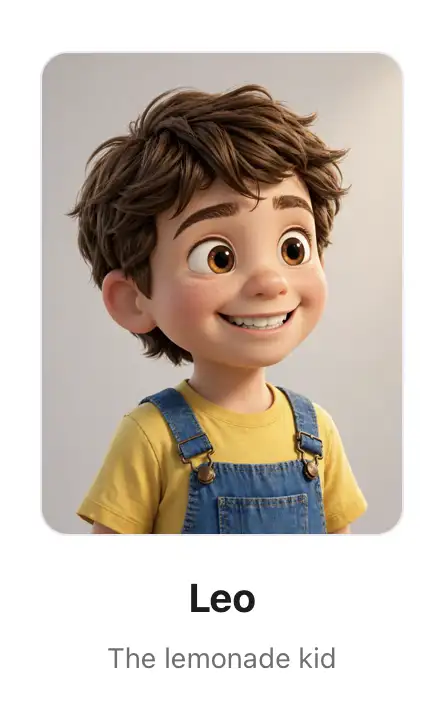
Leo introduces the course. Twenty-nine seconds, one million dollars.
The whole course in 60 seconds
Everything in the next twelve lessons fits on this list.
From The Million Dollar Lemonade Stand, the Studio book. Leo lived every one of these.
The twelve lessons

Lesson 1
This is Leo. He is 8 years old. He loves sunny days and he loves lemons. One hot day he said, "I want to make lemonade for my whole street!" That was his big idea.
Most big ideas die right there, as a sentence on a hot day. Leo's did not, because he did the thing next: he squeezed the lemons. Every business you admire started exactly this way, with someone doing the first small real thing instead of just talking about it.
Lesson 2
Leo squeezed fresh lemons. Added water. Added a little sugar. Sip... too sour! Sip... just right! He did not sell the sour version. He kept tasting until it was yummy.
This is the whole secret of product, and grown-up companies pay consultants millions to learn it: a great product is something people love and want again. Not something clever. Not something new. Something people want a second cup of.
Lesson 3
Leo built his stand out of wood and paint, filled one big pitcher, and sold his first cup for $1. His neighbor smiled and said, "This is delicious!" Best dollar ever.
But here is the part most people miss: that $1 is not all profit. The lemons, sugar, and cup cost about 30 cents. The other 70 cents is profit, the money Leo actually keeps. Profit is the whole game. Revenue is vanity, profit is sanity.
Where Leo's $1 goes
Every cup: 30 cents of lemons, sugar, and cup. 70 cents Leo keeps. Sell 100 cups, keep $70.
Lesson 4
No one knew Leo was there! The best lemonade on the street, invisible. So Leo made a BIG yellow sign. He waved. He smiled. He told everyone at the park. Visibility means people can SEE you and FIND you.
This is marketing, the whole of it, no degree required. Great product plus nobody knowing equals zero dollars. Decent product plus everybody knowing equals a line around the block. Leo chose the line.
Lesson 5
Too busy! The line got longer... and longer... and LONGER! Leo had to squeeze, pour, smile, count money, and get more ice, all at the same time! He could NOT do it all alone.
This is the best problem in business and it still kills businesses: demand beating capacity. One person doing five jobs means all five jobs get done badly. The fix is not working harder. Leo was already working as hard as an 8-year-old can. The fix is help.
Lesson 6
Leo asked his friends. "Will you help me?" Maya said YES. Ben said YES. Sofia said YES. Now Leo had a TEAM!
Notice he asked before he was desperate, and he asked friends, people who already wanted him to win. Your first team is never hired from a job board. It is the people around you who believe in the thing.
Lesson 7
Everyone had one job. Leo: leader and founder, the big idea plus team cheerleader. Maya: maker, every cup tastes just right. Ben: money, counts coins and says thank you. Sofia: welcome, waves, smiles, invites people over. Plus helpers and neighbors bringing lemons, ice, and cups.
This is called an org chart. Say it: org chart. It is a picture that shows who does what and who helps who. When everyone does ONE job well, everything works better.
Leo's org chart
Lesson 8
Friends outside the team can help too! The bakery gave Leo cups. Leo put their cookies by his stand. The grocery store gave him lemons. Leo told everyone where to shop.
A partnership is when two teams help each other and both teams win. Leo did not pay for cups. The bakery got cookie sales. The grocery got shoppers. Nobody lost. That is the test: if both sides win, it is a partnership. If one side wins, it is just a favor with paperwork.
How Leo's partnerships worked
Lesson 9
One stand became... MANY! Happy people told their friends. Their friends told MORE friends. Soon there were stands at the park, at games, and at school fairs. Same yummy lemonade. Same great team.
Growth is just doing the working thing in more places. Leo did not invent a second product. He copied the first one. New locations, same recipe, same org chart, same big yellow sign. Boring is beautiful when boring works.
Lesson 10
Cup after cup. Day after day. Smile after smile. $1,000,000. Leo and his team did it! They did not do it alone. They did it TOGETHER.
A million dollars sounds impossible until you do the math. It is just cups times profit times days times stands. Small numbers, repeated relentlessly, become enormous numbers. That is the entire secret of the million.
The million-dollar math
Lesson 11
How Leo did it. That is how you build a small business:
Make something yummy that people love.
Let people see you. Big sign, big smile.
Ask friends to help. Give everyone a job.
Draw who does what, so everyone knows.
Help other teams, and let them help you.
Tape this to your wall. Every business book ever written is these five rules with fancier words.
Lesson 12
Now YOU try! What would YOU sell? Lemonade? Cookies? Songs? Drawings? You can build something big. Start small. Start today.
Graduation
Leo was 8, with lemons and a wooden stand. You have everything he had, plus the internet. The only difference between you and the million is the first cup.
Keep learning
This course is part of Starvard University, striving for greatness.
Explore Starvard · AI Agents: Your First $10,000 · Business 101: Online Edition